
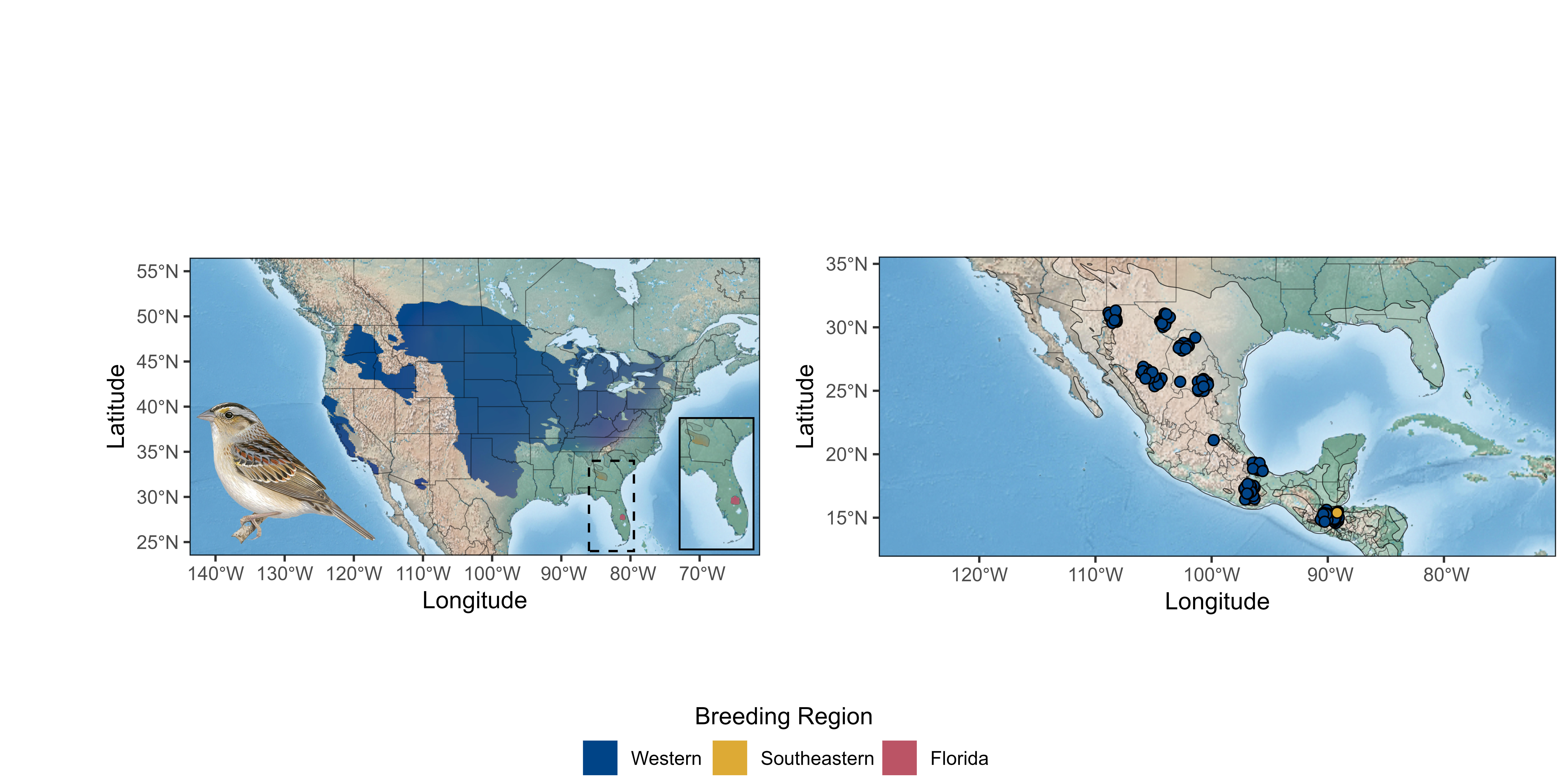
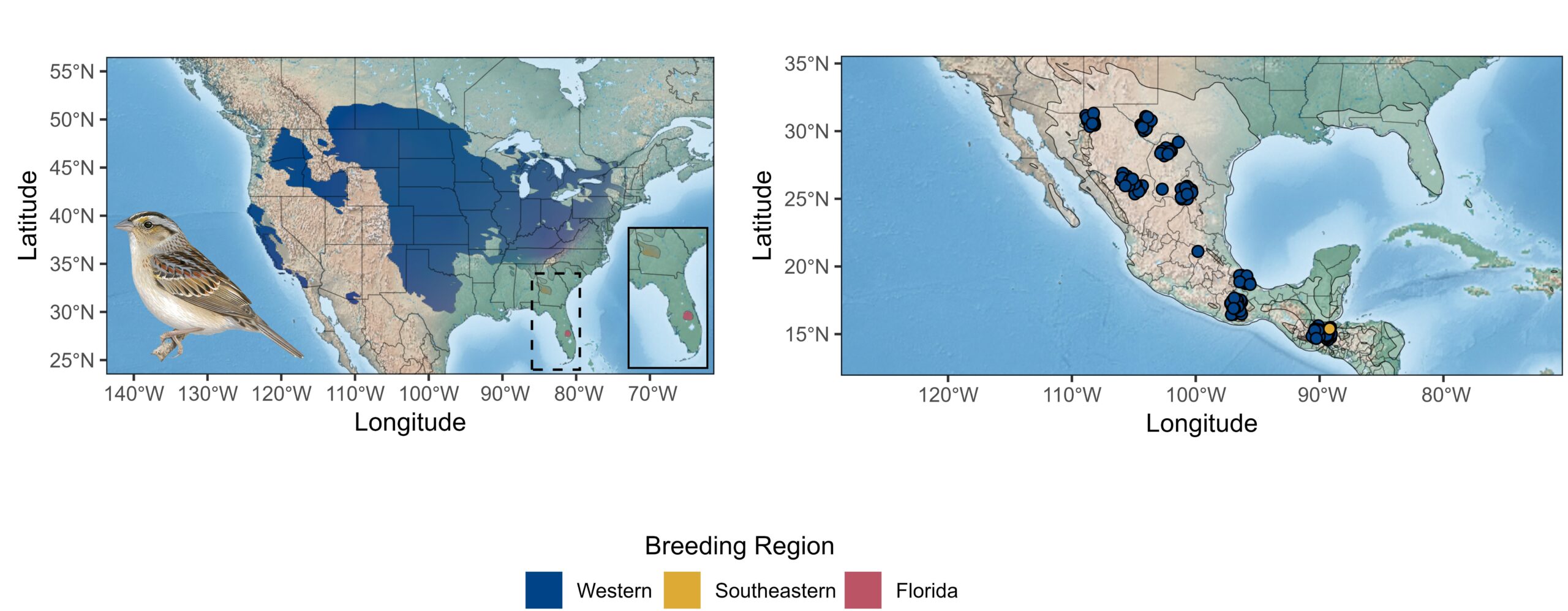
The three genetically distinct populations of Grasshopper Sparrow (Ammodramus savannarum) (left map) across the breeding range: Western (blue), Southeastern (yellow), and Florida (red). Individuals sampled on the wintering grounds (right map) were then assigned back to a genetic cluster, allowing us to better understand the migratory connectivity of Grasshopper Sparrow populations. Genetic clusters are visualized as transparency levels of different colors overlaid overlaid upon a base map from Natural Earth (naturalearthdata.com) and clipped to the species breeding range using an eBird shapefile. Grasshopper Sparrow Image by © Birds of the World
Grasshopper Sparrows (Ammodramus savannarum) are a common sight across much of North America and their high, reedy songs are emblematic of open prairie. Unfortunately, like many grassland bird species, they have undergone drastic population declines (> 60%) over the last several decades, prompting conservation efforts. Previous work found that the population was panmictic (i.e. one genetic breeding population) across the entirety of North America, although sequencing and sampling efforts were somewhat limited.
Team
Jim Austin and Celine Carneiro at the University of Florida, Brandt Ryder and others at the Bird Conservancy of the Rockies, Andy Boyce at the Smithsonian Institute’s Center for Conservation Genomics, Irene Ruvalcaba Ortega and Ricardo Canales at the Universidad Autónoma de Nuevo León, Nancy Mahony at Environment and Climate Change Canada, Alice Boyle at the University of Western Ontario, Blanca Estela Hernandez Banos at the Museo de Zoología, and others.
Results and future work
We have identified three distinct genetic groups: one in Western and one in Southeastern North America, and one in Florida (resident). We also sampled individuals on their non-breeding grounds, allowing us to identify linkages between breeding and non-breeding populations. Our ongoing work seeks to identify relationships between spatial genetic diversity and population abundances and growth rates across the Grasshopper Sparrow range.
If you are interested in collecting or donating Grasshopper Sparrow samples from any location across its breeding and wintering grounds, please contact us via email to learn more about how you can contribute to the project!