
American Crow
American Crows (Corvus brachyrhynchos) exhibit a mixed migratory strategy: they overwinter in communal flocks composed of both year-round residents and long-distance migrants. We will use a genoscape to understand the migratory pathways of American crows, and to compare behavioral, pathogen interactions, and other phenotypic differences between migratory and year-round birds overwintering in the same populations.
Team: We worked with Andrea Townsend of Hamilton College, Kevin McGowan of Cornell University, Doug Robinson of Mount Saint Mary’s College, Anne Clark of Binghamton University, Carolee Caffrey of the College of New Jersey, and others to construct a genoscape for the American Crow.
Results: We’ve identified 5 genetically distinct populations of the American Crow – West (purple), Midwest (orange), South (green), New York (blue), and Northeast (pink). The open, uncolored space on the map with three black dots between the blue, orange, and green genetic groups are areas of admixture.
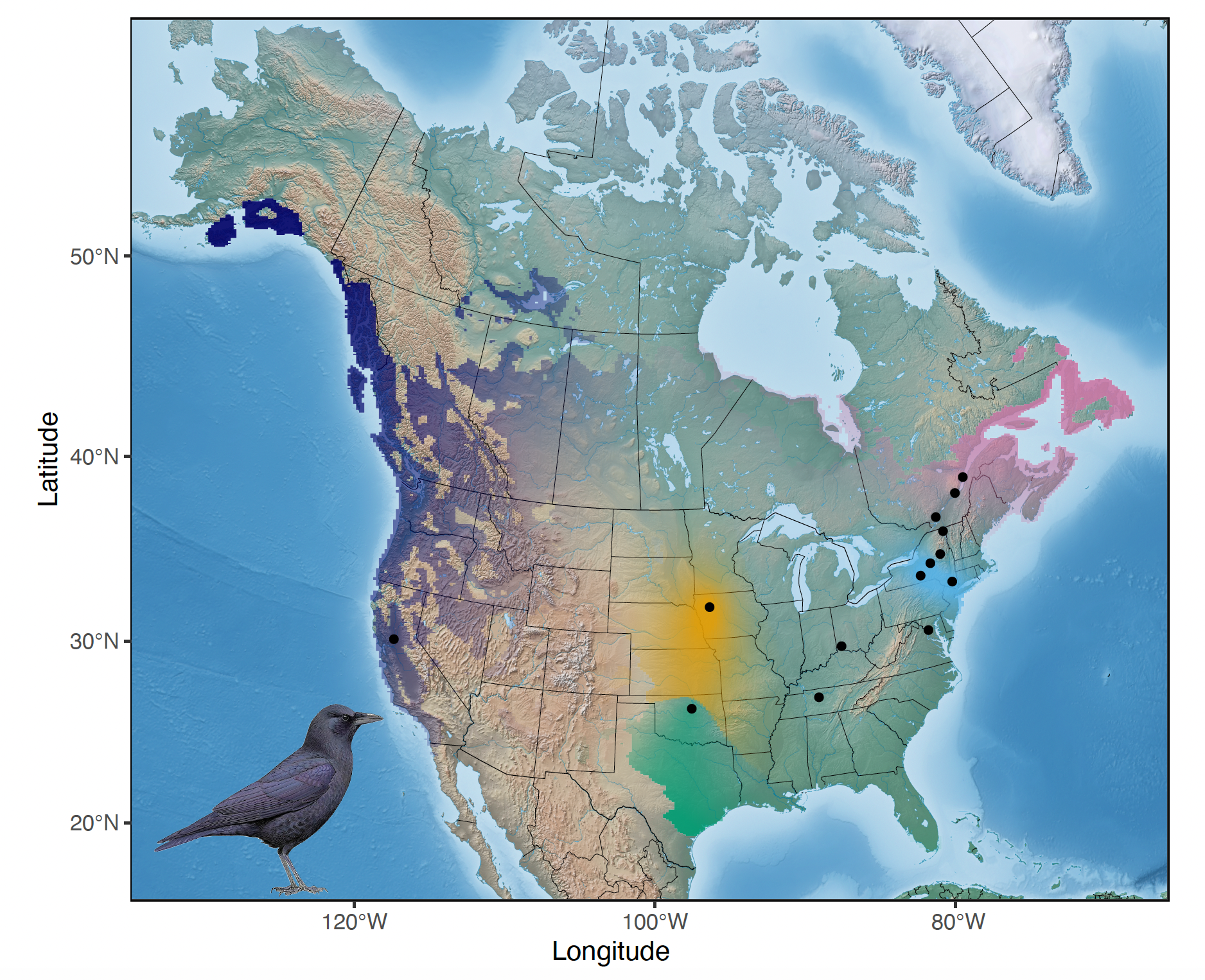
The five genetically distinct populations of American Crows (Corvus brachyrhynchos) across its range: West (purple), Midwest (orange), South (green), New York (blue), and Northeast (pink). Genetic clusters are visualized as transparency levels of different colors overlaid upon a base map from Natural Earth (naturalearthdata.com) and clipped to the species breeding range using an eBird shapefile. American Crow Image by © Birds of the World